 by
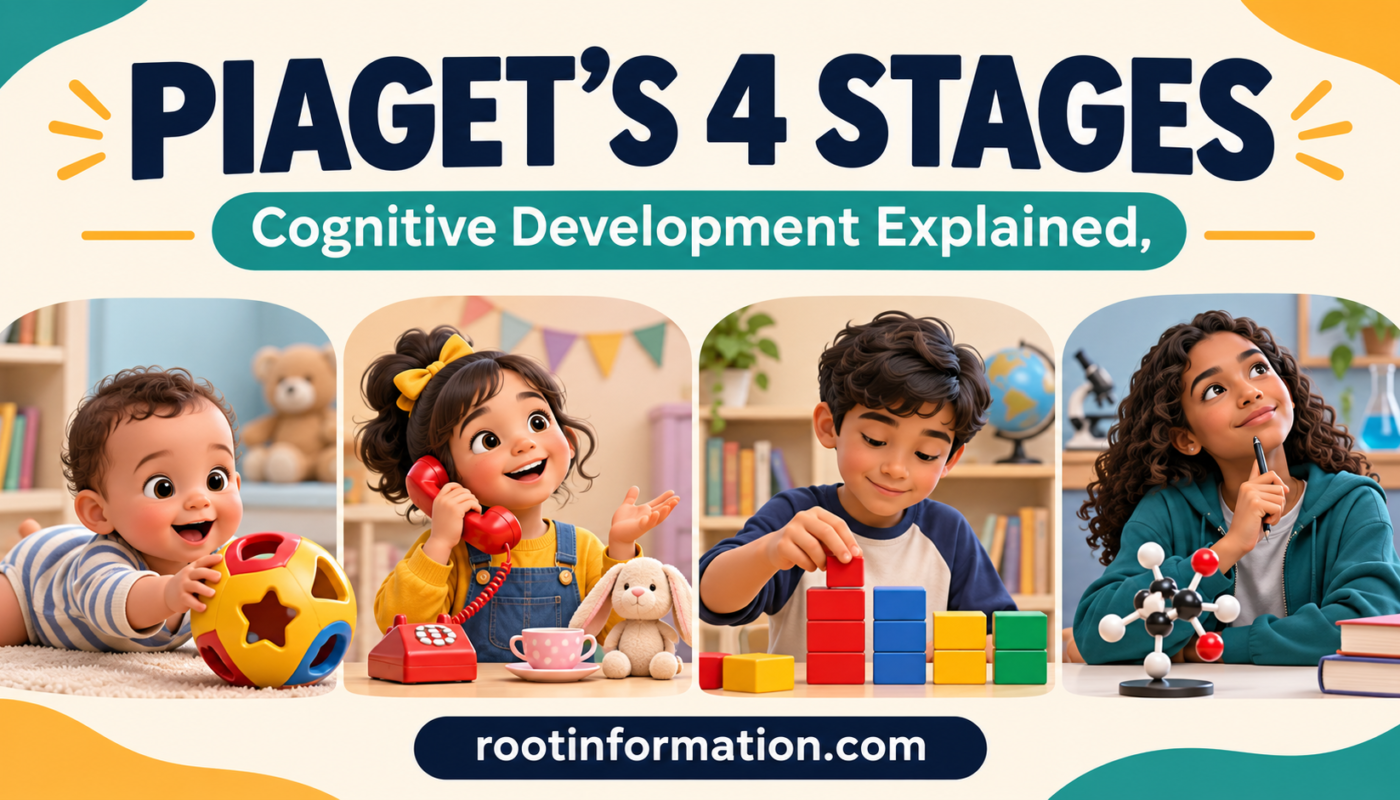
Piaget’s stages of cognitive development describe four broad changes in how children understand the world: sensorimotor, preoperational, concrete operational, and formal operational thinking. The theory explains a progression from learning through actions to reasoning about objects, ideas, and possibilities.
For parents and teachers, its value lies in asking a practical question: How is this child thinking about the task?
A preschooler pretending that a block is a telephone and a teenager testing a scientific explanation are using different kinds of thinking. Piaget’s theory provides a framework for discussing these differences.
The age ranges are approximate. They should not be used as deadlines or as a complete assessment of an individual child.
What Are Piaget’s Stages of Cognitive Development?
Jean Piaget was a Swiss psychologist who studied how children construct knowledge. He proposed that children actively organize their experiences rather than simply absorb information.
His theory describes four stages, each associated with characteristic ways of thinking. Educational texts sometimes give slightly different age boundaries.
For broader background, read our guide to the stages of human development, which considers development beyond thinking alone.
Piaget’s Stages of Cognitive Development: Age Chart
| Stage | Approximate age | Central idea | Everyday illustration |
|---|---|---|---|
| Sensorimotor | Birth to 2 years | Learning through senses and actions | Searching for a hidden toy |
| Preoperational | 2–7 years | Using symbols, language, and mental images | Pretending a block is a telephone |
| Concrete operational | 7–11 years | Applying logical operations to concrete situations | Understanding that rearranging objects does not change their number |
| Formal operational | About 11–12 years onward | Reasoning about abstract and hypothetical possibilities | Planning how to test competing explanations |
These ranges summarize Piaget’s model. A person’s performance also depends on the task, familiarity, instruction, and context.
1. Sensorimotor Stage: Learning Through Actions
During the sensorimotor stage, infants explore through looking, reaching, grasping, and moving.
A baby may repeat an action after noticing an interesting result. Shaking a toy and hearing a sound provides an opportunity to connect an action with an outcome.
Object Permanence
Object permanence means understanding that something continues to exist when it is out of sight.
Example: An adult hides a familiar toy beneath a cloth. The child looks for it instead of treating its disappearance as permanent.
The emergence of this understanding is more complex than one successful or unsuccessful attempt. A task also places demands on attention, memory, and movement.
Activity Idea
Let an infant explore suitable large toys with different textures under adult supervision. Respond to their interest and allow them to repeat actions.
The purpose is shared exploration, rather than testing whether the child has “passed” a stage.
2. Preoperational Stage: Symbols and Pretend Play
During the preoperational stage, children make increasing use of language, pictures, and pretend play.
A child might use an empty box as a bus or assign different characters to toy animals. One object can represent another.
However, Piaget argued that children’s reasoning at this stage often depends heavily on appearances.
Egocentrism
In Piaget’s theory, egocentrism refers to difficulty taking another person’s perspective. It does not simply mean selfishness.
Example: A child describes a picture without realizing that the listener cannot see it.
A helpful adult might ask, “What would you need to tell someone who has not seen the picture?”
Centration
Centration means focusing on one noticeable feature while overlooking other relevant features.
Example: After water is poured from a short, wide container into a tall, narrow one, a child may judge the amount by the water’s height alone.
Activity Idea
Use pretend shops, puppets, picture stories, and role-play. Ask children to explain what characters can see, know, or want.
3. Concrete Operational Stage: Logic With Concrete Situations
In the concrete operational stage, children become more successful at logical operations involving tangible objects and familiar situations.
They can increasingly coordinate several features of a problem.
Conservation
Conservation is understanding that a quantity can remain unchanged despite a change in appearance.
Example: Spread six counters farther apart. The row becomes longer, but the number remains six.
Reversibility
Reversibility involves mentally undoing an operation.
Example: A child understands that adding four objects and then removing those same four returns the collection to its starting amount.
Classification and Ordering
Children may become more systematic when grouping objects or arranging them by a characteristic.
Example: They sort a mixed collection by shape and then reorganize it by colour.
Activity Idea
Use counters, fraction strips, measuring tools, and sorting materials. Ask students to explain why an answer remains the same after objects are rearranged.
4. Formal Operational Stage: Thinking About Possibilities
The formal operational stage concerns reasoning beyond immediately visible objects.
Piaget associated it with hypothetical thinking, abstract ideas, and systematic investigation.
Hypothetical Reasoning
A learner can consider what might happen under a condition that is not currently present.
Example: “How might transport change if a city stopped allowing private cars?”
Systematic Investigation
A student can plan how to compare explanations while controlling relevant variables.
Example: To investigate how light affects a plant’s growth, students discuss keeping other conditions as similar as possible.
Formal reasoning is not automatically used in every situation. Familiarity and education influence how people approach a problem.
Activity Idea
Introduce debates, alternative explanations, and investigations. Ask students to distinguish evidence from assumptions.
How Learning Works in Piaget’s Theory
Piaget also described processes that help explain changes in understanding.
| Concept | Meaning | Illustrative example |
|---|---|---|
| Schema | An organized pattern of knowledge or action | A child’s understanding of a bicycle |
| Assimilation | Interpreting experience using an existing schema | Recognizing an unfamiliar bicycle as a bicycle |
| Accommodation | Revising a schema when it does not fit | Adjusting the idea that every cycle has two wheels |
| Equilibration | The process of resolving mismatches in understanding | Developing a more flexible understanding of different cycles |
These processes help explain why encountering an unexpected example can lead to questions and revised ideas.
The OpenStax overview of developmental theories introduces Piaget’s framework alongside other perspectives on development.
Using Piaget’s Stages of Cognitive Development in Teaching
The following suggestions are practical applications of the framework rather than rules that Piaget’s theory proves must work for every student.
Begin With Students’ Explanations
Ask learners how they reached an answer.
Two students may choose the same incorrect answer for different reasons. Their explanations can reveal what needs clarification.
Connect Objects, Pictures, and Symbols
For a new mathematical idea, demonstrate with materials, represent it with a drawing, and then introduce notation.
Continue to use concrete examples when they help older learners understand an unfamiliar topic.
Provide Appropriate Challenges
Choose tasks that extend current understanding while allowing support.
A stage label should not become a reason to withhold an opportunity to learn.
Revisit Ideas in Different Contexts
A student may solve a problem with familiar objects but struggle with an abstract version. Use varied examples before assuming that understanding transfers automatically.
Limitations of Piaget’s Stages of Cognitive Development
Piaget’s framework remains influential, but it is not a complete account of learning.
Age boundaries are approximate. Children do not all demonstrate the same abilities on the same birthday.
Performance varies between tasks. Instructions, language, memory demands, and familiarity can affect results.
Some abilities appear earlier than Piaget’s original tasks suggested. Later research has challenged parts of his account of infant understanding.
Development is not always a neat staircase. A learner may show sophisticated reasoning in one area while needing concrete support in another.
Social and cultural experiences matter. Teaching, conversation, and the activities available to children influence their opportunities to learn.
For an introduction to evidence that revised earlier accounts of children’s abilities, see the OpenStax discussion of stages of development.
Use the theory to guide questions and observations, while remaining open to what the individual learner demonstrates.
Frequently Asked Questions
1. What are Piaget’s four stages?
They are sensorimotor, preoperational, concrete operational, and formal operational.
2. What does cognitive development mean?
It refers to changes in mental processes such as understanding, remembering, reasoning, and solving problems.
3. Are Piaget’s stage ages exact?
No. They are approximate ranges associated with the theory.
4. What is object permanence?
It is understanding that an object continues to exist when it is no longer visible.
5. What is conservation?
It is understanding that a quantity can stay the same when its appearance or arrangement changes.
6. Does egocentrism mean a child is selfish?
Not in this context. It refers to difficulty considering a perspective different from one’s own.
7. How are assimilation and accommodation different?
Assimilation uses an existing understanding to interpret an experience. Accommodation changes that understanding when necessary.
8. Do adults always use formal operational thinking?
No. Reasoning varies with the situation, experience, and knowledge of the subject.
9. Can teachers use the theory today?
Yes, as one framework for considering students’ thinking. It should be combined with observation, effective instruction, and other research.
10. Can the stages diagnose a developmental difficulty?
No. Piaget’s stage chart is an educational model, not a diagnostic assessment.
Final Perspective
Piaget’s stages of cognitive development encourage adults to look closely at how children make sense of experience. Their most useful classroom lesson is to listen to reasoning, offer meaningful activities, and adjust instruction in response to what learners actually understand.