 by
Assimilation vs accommodation describes two ways people respond to new experiences in Piaget’s theory of cognitive development. Assimilation means interpreting an experience through an existing understanding. Accommodation means changing that understanding when it does not adequately fit the experience.
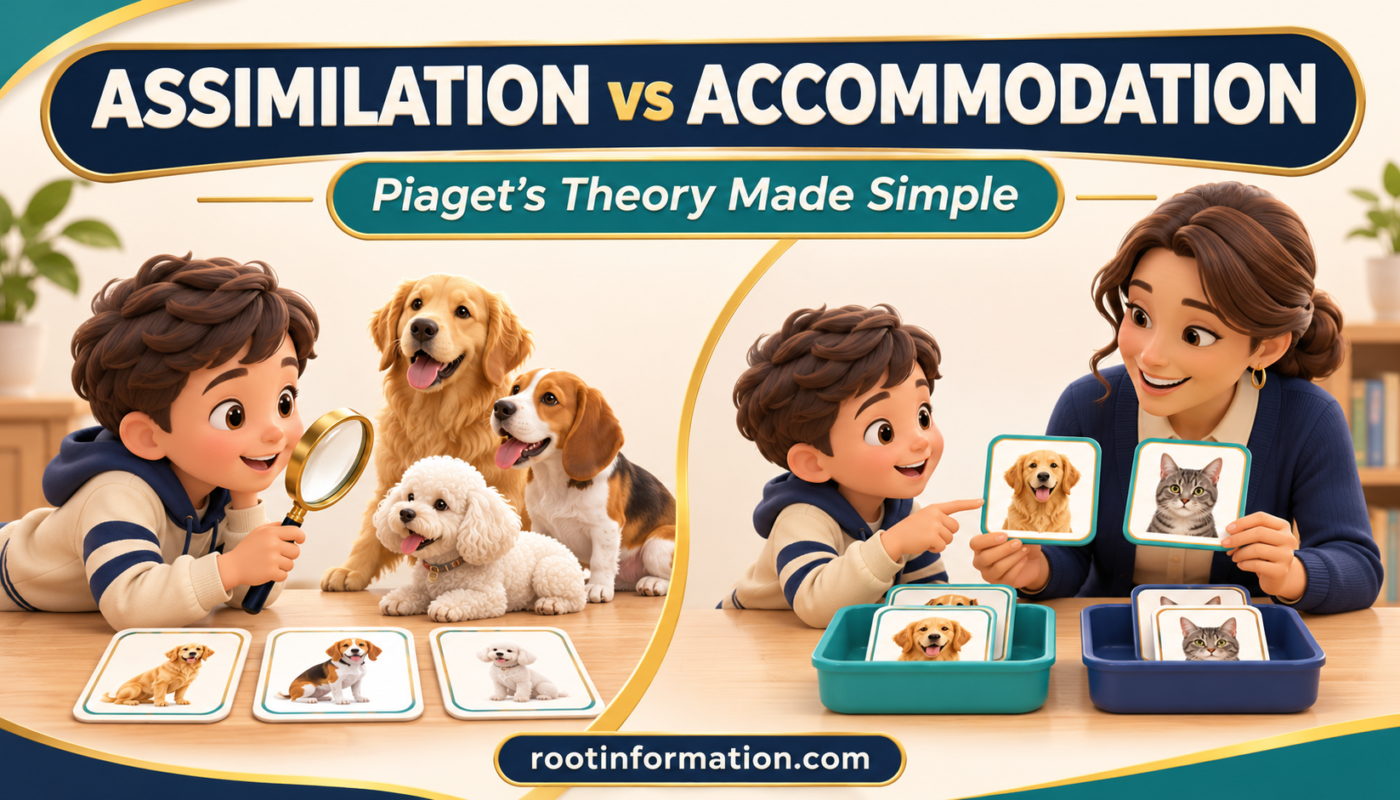
Imagine a child who recognizes several different dogs. Calling an unfamiliar breed a dog can illustrate assimilation. If the child calls a cat a dog, then learns to distinguish the two categories, revising that understanding illustrates accommodation.
The distinction helps explain how learners use what they already know and how their ideas change.
Assimilation vs Accommodation: The Main Difference
The central question is whether the learner’s existing mental framework remains suitable or needs revision.
| Basis | Assimilation | Accommodation |
|---|---|---|
| Main process | Interpreting experience through an existing schema | Revising or creating a schema |
| Role of prior knowledge | Provides a framework for understanding | Becomes something to reconsider |
| Typical situation | The experience seems to fit | The experience reveals a mismatch |
| Animal example | Recognizing an unfamiliar dog breed as a dog | Revising the idea that all four-legged pets are dogs |
| Learning outcome | An existing understanding is applied | Understanding is reorganized |
| Accuracy | Can be accurate or mistaken | Revision may improve understanding but still needs checking |
Neither process is inherently better. Both contribute to adaptation in Piaget’s account.
The OpenStax introduction to cognition in infancy and toddlerhood explains these processes in relation to children’s changing knowledge.
What Is a Schema?
A schema is an organized pattern of knowledge or action that helps a person interpret experience. The plural is “schemas” or “schemata.”
A young child might have a schema for a dog that includes fur, four legs, and barking. Another schema might concern how to hold and turn the pages of a book.
Schemas are useful, but they can be incomplete. Experience can reveal that an initial rule does not cover every case.
For a broader introduction to changes across life, explore our guide to the stages of human development.
Assimilation vs Accommodation in Piaget’s Theory
Piaget described children as active participants in constructing knowledge.
They interpret situations using existing schemas, encounter experiences that challenge those schemas, and sometimes reorganize their understanding.
These processes operate within his wider account of cognitive development. They are not additional stages, and a single instance of accommodation does not mean a child has moved into a new developmental stage.
The OpenStax overview of lifespan theories places assimilation and accommodation within this broader framework.
What Is Assimilation?
Assimilation occurs when someone interprets a new experience using an existing schema.
The learner encounters something unfamiliar but understands it through a familiar category, expectation, or action.
Example: Recognizing a Different Chair
A child knows that chairs are objects people sit on. On seeing a chair with an unfamiliar shape, the child still identifies it as a chair.
The existing understanding is sufficient for interpreting the new object.
Example: Applying a Familiar Method
A student who understands how to add two small groups of counters applies the same approach to a new set of counters.
The objects have changed, but the student uses an established method.
Can Assimilation Be Incorrect?
Yes. An experience may be interpreted through a schema that is too broad.
A child who calls every flying animal a bird is applying an existing category. That interpretation works for a sparrow but fails for a bat.
Assimilation therefore does not necessarily mean that the learner’s answer is correct.
What Is Accommodation?
Accommodation occurs when a learner changes an existing schema or forms a new one because the current understanding does not adequately explain an experience.
The important feature is revision, rather than simply encountering something new.
Example: Recognizing Bats as Mammals
A learner initially believes that every flying animal is a bird.
After examining bats and learning how they differ from birds, the learner revises the classification rule. Flight alone is no longer treated as sufficient evidence.
Example: Understanding Different Triangles
A student recognizes only a familiar upright triangle.
After examining rotated triangles, the student revises the idea that a triangle must point upward. The defining features become three straight sides and three corners.
Does Accommodation Always Produce Complete Understanding?
No. A revised idea can still be incomplete.
Learning may involve several rounds of explanation, observation, and revision. One corrected answer does not establish that the concept will be understood in every context.
Assimilation vs Accommodation: Three Paired Examples
The following examples illustrate the concepts rather than provide tests of a person’s cognitive processes.
| Topic | Assimilation | Accommodation |
|---|---|---|
| Animals | Identifying a new dog breed using an existing dog schema | Revising an overly broad schema to distinguish dogs from cats |
| Shapes | Recognizing another upright triangle | Revising the belief that triangles must always point upward |
| Numbers | Using a familiar whole-number rule in a new calculation | Revising “multiplication always makes numbers larger” after studying multiplication by fractions |
The same topic can involve both processes at different moments.
Equilibration: How the Processes Connect
Piaget used the concept of equilibration to describe the regulation of understanding as people encounter and respond to mismatches.
A simplified teaching example is:
- A learner has an existing explanation.
- A new case does not fit that explanation.
- The learner examines the mismatch.
- The explanation is revised.
- The revised explanation is checked against further cases.
For example, a student may believe that every object made of metal sinks. A metal boat creates a problem for that rule. A lesson can then help the student develop a more adequate explanation involving the object’s overall structure and displacement.
Simply presenting a surprising example may not be enough. Learners also need opportunities to understand and evaluate an alternative explanation.
Using Assimilation vs Accommodation in Teaching
The following classroom suggestions are practical applications of the framework.
Start With Existing Ideas
Ask learners to explain what they expect before introducing a new example.
Questions such as “How would you classify this?” or “What makes you think that?” reveal the understanding they are applying.
Use Familiar Examples First
Begin with examples that connect to established knowledge.
When introducing a new category of shapes, students can first identify familiar examples before considering less familiar orientations.
Introduce a Carefully Chosen Exception
Once the existing idea is clear, present a case that reveals its limits.
If students think larger denominators always mean larger fractions, compare equal-sized wholes divided into halves and eighths.
Help Learners Build a Better Explanation
Do more than announce that the original answer is wrong.
Use diagrams, objects, questions, and explicit explanation to show why an alternative account works.
Check Understanding in a New Situation
Ask students to apply the revised idea to a fresh example.
A student who recognizes one rotated triangle should also examine triangles with different proportions. This helps reveal whether the defining features are understood.
Common Mistakes About Assimilation vs Accommodation
“Assimilation is memorization.”
Assimilation concerns interpreting experience through an existing schema. Memorization alone does not describe that relationship.
“Accommodation means any new learning.”
Accommodation specifically involves revising or creating a schema. Some new experiences can be understood using existing schemas.
“Assimilation is wrong and accommodation is right.”
Assimilation can be accurate. Accommodation can also produce an incomplete revision.
“The processes belong to separate age groups.”
They are processes within Piaget’s theory, rather than age categories.
“Every mistake proves that accommodation is happening.”
An incorrect response does not by itself show how the learner is thinking. Ask for an explanation and look for evidence of revision.
Frequently Asked Questions
1. What is the simplest assimilation vs accommodation difference?
Assimilation uses an existing understanding. Accommodation changes that understanding when needed.
2. What is an example of assimilation?
A child recognizes an unfamiliar dog breed as a dog using an established category.
3. What is an example of accommodation?
A child revises the belief that all four-legged pets are dogs after learning to distinguish cats.
4. What is a schema in Piaget’s theory?
It is an organized pattern of knowledge or action used to interpret experience.
5. Can assimilation lead to an incorrect answer?
Yes. A learner may apply an existing schema too broadly.
6. Does accommodation mean forgetting prior knowledge?
No. It can involve modifying or reorganizing existing understanding.
7. Can adults show these processes?
Yes. The concepts can describe how adults use familiar frameworks and revise them when circumstances change.
8. How does equilibration relate to the two processes?
It concerns how understanding is regulated and reorganized in response to mismatches.
9. How can teachers encourage revision of misconceptions?
Identify the learner’s current explanation, examine a suitable counterexample, teach a clearer alternative, and check understanding again.
10. Are assimilation and accommodation developmental stages?
No. They are processes within Piaget’s theory of cognitive development.
Conclusion
Assimilation vs accommodation explains a useful distinction between applying an existing framework and changing that framework.
For teaching, the practical value is to identify learners’ current ideas, explain where those ideas work, and provide support when a more accurate understanding is needed.