 by
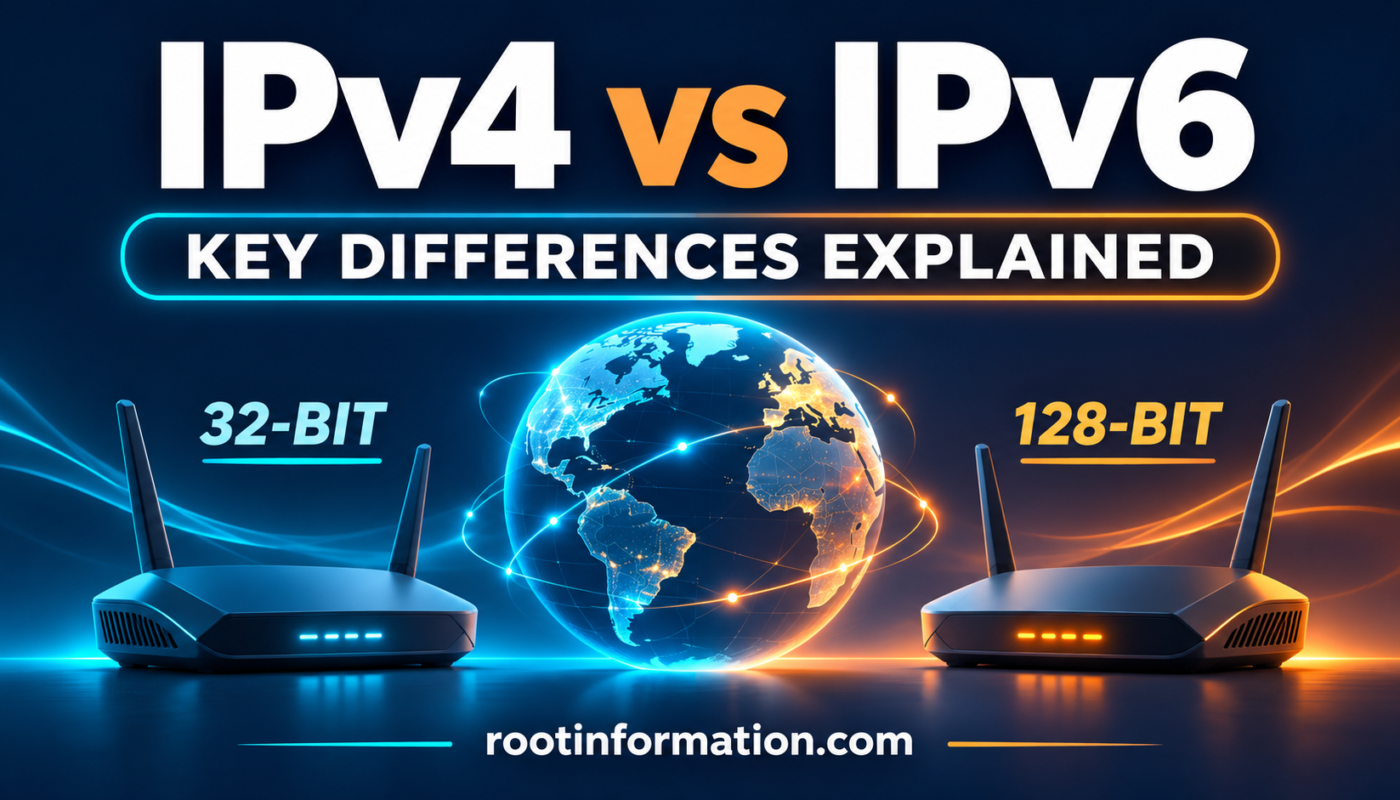
IPv4 vs IPv6 is a comparison between two versions of the Internet Protocol, the system used to address and route packets across networks. IPv4 uses 32-bit addresses, while IPv6 uses 128-bit addresses. This gives IPv6 a vastly larger address space and supports the continued expansion of connected networks.
You may notice both versions in your computer’s network settings. Their presence does not necessarily indicate a problem. A device can use both, depending on the network and the service it accesses.
For background, explore how computer communication began before comparing the addressing systems used today.
IPv4 vs IPv6: Quick Comparison
| Feature | IPv4 | IPv6 |
|---|---|---|
| Address length | 32 bits | 128 bits |
| Typical notation | Four decimal numbers separated by dots | Hexadecimal groups separated by colons |
| Documentation example | 192.0.2.10 | 2001:db8::10 |
| Theoretical address count | About 4.29 billion | About 3.4 × 10³⁸ |
| DNS address record | A record | AAAA record |
| Address configuration | Manual configuration or DHCP | Manual configuration, SLAAC or DHCPv6 |
| Broadcast | Supports broadcast | Uses multicast instead of broadcast |
| Automatic encryption | No | No |
The examples above are reserved for documentation. They are not addresses to copy into your network settings.
What Is IPv4?
IPv4 stands for Internet Protocol version 4. It uses 32-bit addresses, commonly written as four decimal numbers separated by dots.
For example:
192.0.2.10
Each number represents eight bits and can range from 0 to 255.
The complete IPv4 address space contains 2³² possible addresses. However, not all are available as public addresses because some ranges serve private, documentation and other special purposes.
Why IPv4 Address Availability Matters
A finite address space creates pressure as networks grow.
Many home networks use private IPv4 addresses internally and share a public IPv4 address through Network Address Translation, or NAT.
Think of a household with several phones and laptops. Each device needs a local identity, while the router may translate their connections when communicating with the wider internet.
The Internet Society’s IPv6 adoption FAQ explains address exhaustion and the role of transition technologies.
What Is IPv6?
IPv6 stands for Internet Protocol version 6. Its 128-bit addresses provide a much larger addressing system.
An example is:
2001:db8::10
IPv6 addresses use hexadecimal digits, including numbers from 0 to 9 and letters from a to f.
The IPv6 specification, RFC 8200, defines the protocol and its expanded addressing capability.
How IPv6 Address Shortening Works
A full address can contain eight groups:
2001:0db8:0000:0000:0000:0000:0000:0010
Leading zeros within a group can be omitted. One consecutive sequence of all-zero groups can also be replaced by a double colon.
The shortened form becomes:
2001:db8::10
The double colon can appear only once in an address. Otherwise, the number of omitted groups would become ambiguous.
APNIC’s IPv6 address reference includes documentation addresses and other address categories.
IPv4 vs IPv6: Why the Larger Address Space Matters
The main benefit is room for continued network growth.
IPv6 gives network operators substantially more flexibility when allocating addresses to customers, sites and subnets.
However, a larger address space does not mean every device automatically becomes accessible from the public internet. Routing, firewall rules and network policy still determine which connections are allowed.
Consider a building with many rooms. Adding room numbers improves identification, but it does not remove the building’s doors or access controls.
IPv4 vs IPv6 Speed: Which Is Faster?
Neither version is always faster.
Performance depends on the actual network path, congestion, service provider, destination server and device configuration.
One website might perform better over IPv6 because its IPv6 route is more direct. Another destination might perform similarly over both versions.
Therefore, address length alone cannot predict download speed or gaming latency.
For a meaningful comparison, test the same destination under similar conditions. A single speed test does not establish a universal advantage.
IPv4 vs IPv6 Security: Is IPv6 Automatically Safer?
IPv6 does not automatically encrypt your browsing or make a device immune to attacks.
Both versions require appropriate security controls, software updates and firewall configuration. Application protections such as HTTPS remain important.
The Internet Society’s IPv6 security FAQ discusses security considerations beyond address size.
Similarly, NAT should not be treated as a complete replacement for a firewall. Address translation and traffic filtering perform different functions.
Can IPv4 and IPv6 Work Together?
Yes, but they are different protocols.
Dual Stack
A dual-stack device or network supports both versions.
For example, a laptop may connect to one service over IPv6 and another over IPv4. This does not mean every connection uses both simultaneously.
Translation
Translation mechanisms help connect environments using different versions.
For example, NAT64 can allow IPv6 clients to reach IPv4 destinations in a suitably configured network. DNS64 can assist by synthesizing appropriate DNS responses.