
 by
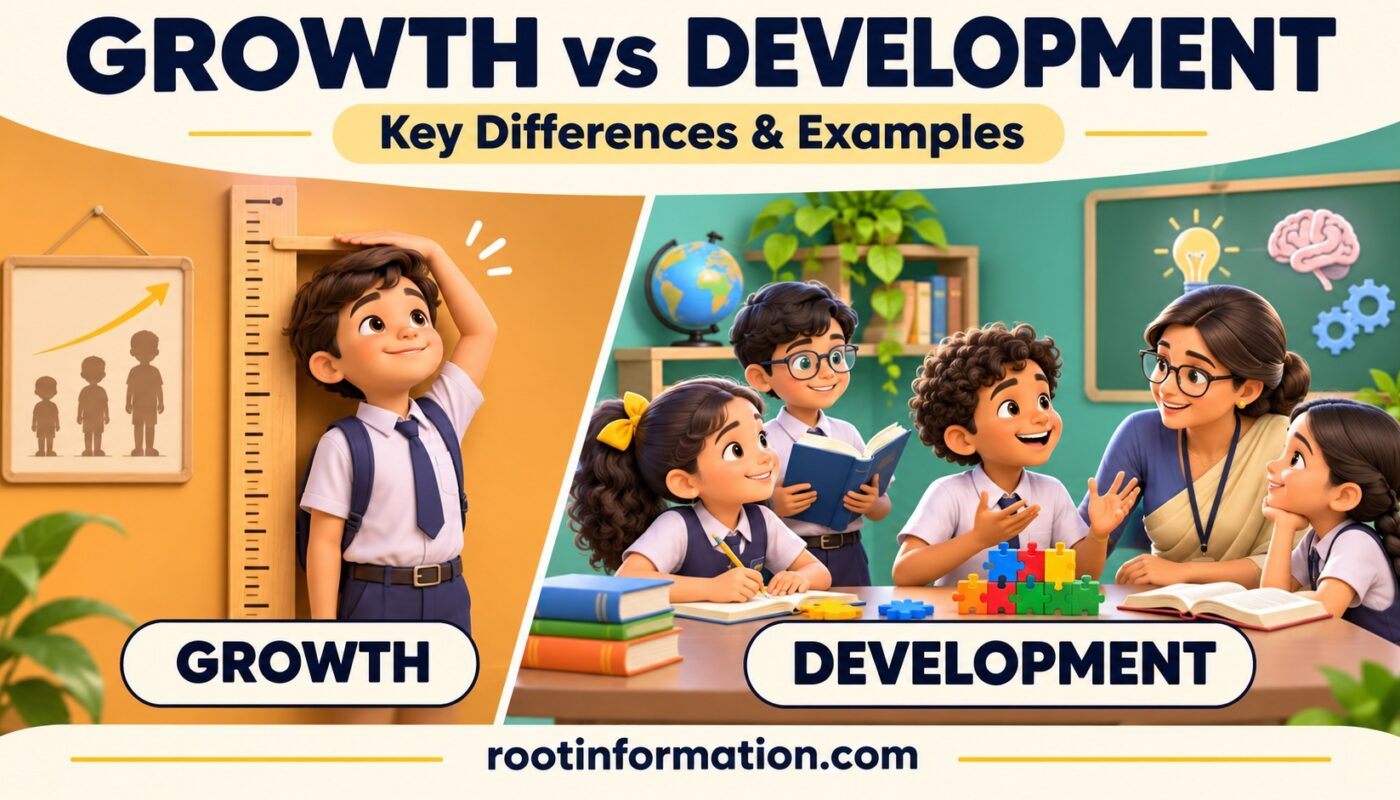
The growth and development difference lies in their scope: growth refers mainly to an increase in physical size, while development includes broader changes in abilities, functioning, and behaviour. A child becoming taller shows growth. Learning to explain an idea, coordinate movements, or cooperate with classmates shows development.
These processes are connected. Physical growth is one aspect of human development, but a person’s height alone cannot tell us how they think, communicate, or manage everyday tasks.
Understanding the distinction helps students answer examination questions and helps teachers interpret children’s progress more carefully.
Growth and Development Difference: Basic Meaning
In everyday conversation, people often use “growth” and “development” interchangeably. In child development and educational psychology, distinguishing them makes observations more precise.
The NCERT human development chapter available through IIT Kanpur’s SATHEE platform describes growth as an increase in the size of the body or its parts and places it within the broader process of development.
For the wider life-course context, explore our article on the stages of human development.
What Is Growth?
Growth means an increase in physical dimensions, such as height, body mass, or the size of body parts.
These changes can be expressed using measurements.
Examples of growth include:
- A child becoming taller over a year.
- An infant gaining body mass.
- A child’s hands increasing in size.
Growth does not occur at the same rate throughout childhood. Different body parts also follow different patterns.
What Is Development?
Development includes changes in physical functioning, thinking, language, emotions, and relationships across life.
It concerns how a person’s abilities and ways of functioning change, rather than physical size alone.
Examples of development include:
- Learning to use a spoon.
- Explaining the sequence of a story.
- Understanding another person’s viewpoint.
- Learning to negotiate during group work.
Development can involve both measurable changes and changes in the quality or organization of behaviour.
Growth and Development Difference: Comparison Table
| Basis | Growth | Development |
|---|---|---|
| Meaning | Increase in physical size | Broader changes in abilities, structure, and functioning |
| Scope | Mainly physical dimensions | Physical, cognitive, language, social, and emotional domains |
| Nature | Primarily quantitative | Includes quantitative and qualitative changes |
| Example | Becoming taller | Becoming more coordinated |
| Assessment | Physical measurements | Observations, tasks, work samples, and suitable assessments |
| Units | Centimetres, kilograms, and other physical units | No single unit applies to every domain |
| Time course | Height growth generally levels off after physical maturity | Continues across the lifespan |
| Relationship | One component of development | The broader process that includes growth |
The NIOS lesson on growth and development provides additional background on physical growth and changes in children’s functioning.
Growth and Development Difference in Everyday Examples
1. Hand Size and Writing Ability
An increase in the size of a child’s hand is growth.
Improved control when drawing shapes or writing letters is development. Writing also depends on instruction, familiarity with letters, and practice.
A larger hand does not automatically produce better handwriting.
2. Height and Participation in Games
Becoming taller is a physical growth change.
Learning the rules of a game, coordinating movements, and cooperating with teammates involve development.
A teacher should therefore consider more than height when planning activities or assigning roles.
3. Physical Size and Communication
A child’s body may become larger over time.
Meanwhile, their communication may change from short requests to explanations, questions, and connected stories.
These changes illustrate why physical measurements cannot provide a complete picture of progress.
4. Adulthood and New Learning
An adult may show little change in height while learning a language, adapting to a new job, or developing a practical skill.
Development therefore continues after the main period of height growth has ended.
How Growth and Development Work Together
Growth and development are different concepts, but they are not independent processes.
Changes in the body can create new possibilities for action. At the same time, experience and practice help a person use their abilities in different ways.
Consider a child learning to draw. The activity involves physical control, visual attention, understanding the task, and experience with drawing materials.
Looking only at the child’s physical size would overlook most of what the activity requires.
Growth, Development, Maturation, and Learning
These four terms describe related aspects of change.
| Term | Main meaning | Example |
|---|---|---|
| Growth | Increase in physical size | A child becomes taller |
| Development | Broader change in functioning | A child gives a clearer explanation |
| Maturation | Biological changes associated with readiness | Movement control becomes more established |
| Learning | Change through experience or practice | A child learns how to form a letter |
For classroom purposes, readiness and instruction both matter. A task may require physical coordination as well as explanation, demonstration, and practice.
Why the Growth and Development Difference Matters in Education
Choose Tasks According to Readiness
Students need activities that connect with their existing abilities.
For example, a child who struggles with small written letters might benefit from larger drawing movements and guided practice. The teacher can adjust the task while continuing to observe progress.
Assess More Than Physical Appearance
A tall student should not automatically be expected to show greater emotional maturity or academic understanding.
Teachers need direct evidence of the ability they want to assess.
To assess storytelling, listen to the student retell a story. To assess cooperation, observe participation in a shared task.
Use Different Forms of Evidence
Written work is useful, but it does not reveal every skill.
Teachers can also use discussion, demonstrations, practical tasks, and observation. This gives students several ways to show what they understand.
Recognize Individual Progress
Children of the same age can differ in their experiences and pace of change.
Compare a student’s work across time, identify the next learning need, and provide specific feedback. Avoid turning one performance into a permanent label.
Common Misconceptions About Growth and Development
“A bigger child is more developed in every way.”
Physical size does not establish a child’s language, reasoning, or social abilities.
“Development is only qualitative.”
Development includes qualitative changes, but some aspects can also be described quantitatively. For example, vocabulary size can be counted, while the way words are organized into an explanation requires a broader assessment.
“Development cannot be assessed.”
It can be assessed using appropriate methods. The method must match the ability being examined.
“Development ends when height stops increasing.”
Development continues through adulthood and older age.
“Development always means improvement.”
A lifespan perspective includes gains, adaptation, and losses. Different abilities can change in different directions.
Frequently Asked Questions
1. What is the main growth and development difference?
Growth mainly concerns an increase in physical size. Development includes broader changes in abilities and functioning.
2. Is growth part of development?
Yes. Physical growth is one aspect of the broader developmental process.
3. Is gaining height an example of growth?
Yes. Height increase is a measurable physical change.
4. Is learning to speak an example of development?
Yes. Language development involves changes in communication and understanding.
5. Can development continue without an increase in height?
Yes. Adults can acquire knowledge, skills, and new ways of managing responsibilities after height growth has ended.
6. Are growth and development equally fast in every child?
No. Children differ, and the pace can also vary between domains within the same child.
7. How is growth measured?
Physical growth can be described using measurements such as height and body mass.
8. How is development assessed?
Methods include observation, age-appropriate tasks, work samples, and suitable assessments of particular abilities.
9. What is the difference between maturation and learning?
Maturation concerns biological changes associated with readiness. Learning involves change through experience and practice.
10. Why should teachers understand this distinction?
It helps them choose appropriate activities, interpret performance, and assess abilities without relying on physical appearance.
Conclusion
The growth and development difference becomes clear when we distinguish physical size from the wider process of changing abilities and functioning.
Teachers and parents can use this distinction to observe progress more accurately, provide suitable learning experiences, and recognize that each person’s development extends beyond physical measurements.